

|
Quantity
|
Total
|
||
|
|
|||
|
|
|||
SINO Optical Linear Encoders (Linear Scales for Machine Tools)
SINO optical linear encoders represent the industry standard for reliability and precision in machine tool retrofitting and Digital Readout (DRO) system integration. Operating on the principle of photoelectric scanning of a high-precision glass scale with a 20 µm grating pitch, these sensors provide real-time, ultra-stable position feedback.
By implementing SINO linear scales, mechanical backlash from lead screws is completely eliminated from the position calculations, ensuring extreme accuracy during milling, turning, boring, and grinding operations.
Encoder Modifications & Series
- SINO KA-300: Universal and most popular series with a 25x34 mm profile cross-section. Ideal for standard lathes and milling machines. Measuring length: 70 mm to 1020 mm.
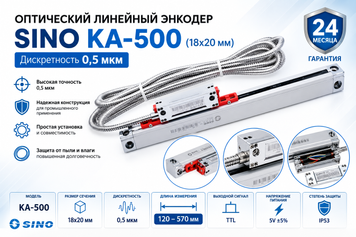
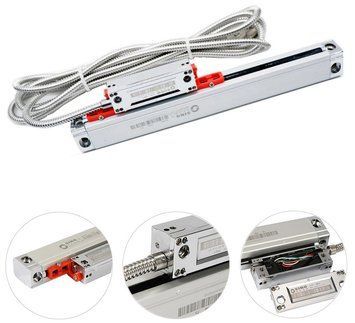
- SINO KA-500: Compact, slim-line series with an ultra-thin 18x20 mm cross-section. Specially designed for cross slides, surface grinders, and areas with severe space constraints. Measuring length: 70 mm to 470 mm.
- SINO KA-600: Heavy-duty series featuring a rigid, large 30x43 mm profile. Engineered to prevent sagging and vibration over long spans. Primarily used for large-scale boring mills, gantry, and portal machines. Measuring length: 1000 mm to 3000 mm.
Technical Specifications
| Parameter | Technical Value |
|---|---|
| Available Resolution | 0.5 µm / 1 µm / 5 µm (0.1 µm optional) |
| Grating Pitch | 20 µm (0.02 mm) |
| Output Signal Type | TTL / Differential RS-422-A (EIA-422-A) |
| Supply Voltage | 5V DC ±5% (24V DC available on request) |
| Maximum Response Speed | Up to 60 meters per minute |
| Enclosure Protection Class | IP55 (dust and splash-proof) |
| Sealing Seals | Multi-layer oil and wear-resistant polyurethane lips |
| Housing Material | High-strength anodized aluminum alloy |
Advantages of the RS-422-A Signal in Industrial Environments
SINO linear scales are supplied with an RS-422-A interface type as a primary option. The utilization of differential data transmission lines (A, /A, B, /B, Z, /Z) guarantees superior noise immunity against electromagnetic interference (EMI). This eliminates signal distortion and axis counting errors, even when cables run parallel to high-power motor lines and variable frequency drives (VFD inverters).